

🧠 What is Turing Test, and Why Are We Still Talking About It?
What is Turing Test? Simply put, it’s one of the most iconic questions in the world of Artificial Intelligence, a test that asks, “Can machines think like humans?”
Back in the 1950s, before the era of ChatGPT and smart assistants, British mathematician Alan Turing imagined a game where a computer could be mistaken for a human just through conversation. That simple yet powerful idea became the Turing Test, and even today, it shapes how we judge a machine’s intelligence.
From Siri to GPT-4.5, the way we define true intelligence in machines still circles back to Turing’s question.
📍 Blog Quick Navigation
✨ What If a Machine Could Think Like You?
Imagine you’re chatting with an AI like ChatGPT, and for a moment, you forget that you’re not talking to a human.
It understands your mood, answers with empathy, and even cracks a joke at the right time.
You pause and think — “Is this thing really thinking like me?“ 🤔
Welcome to the world of the Turing Test — one of the most fascinating and foundational ideas in the journey of Artificial Intelligence.
Back in the early days of computing, a brilliant mathematician named Alan Turing asked a bold question:
“Can machines think?”
And from that one question came a test that has challenged scientists, philosophers, and engineers for over 75 years.
Before we go deeper, if you’re curious about how AI evolved from simple rule-based systems to intelligent models like Gemini and GPT, you can read our detailed blog on the Evolution of Artificial Intelligence — it sets the perfect background for understanding the Turing Test.
Now, in 2025, we are surrounded by smart assistants, AI customer care bots, and content generators. But the core question remains the same:
“Is this intelligence real… or just an illusion?”
That’s where the Turing Test still plays a crucial role.
It’s not just a test — it’s a mirror, reflecting how close machines are getting to human-level intelligence.
In this blog, we’ll explore:
- 🔍 What is Turing Test in the simplest way
- 📜 Why Alan Turing created it in 1950
- 🧠 Whether modern AIs like ChatGPT can pass it
- 🤖 Its impact, limitations, and future role in AI
Let’s begin by meeting the legend who started it all — Alan Turing.
👨🏫 Who Was Alan Turing – The Man Behind the Turing Test

Alan Turing wasn’t just a computer scientist — he was a genius far ahead of his time.
During World War II, Turing worked at Britain’s codebreaking center in Bletchley Park and played a key role in cracking the Enigma code, which drastically shortened the war. But his contributions didn’t stop there. He laid the mathematical foundation of modern computing and Artificial Intelligence.
He’s often called:
- The Father of Computer Science
- The Pioneer of Artificial Intelligence
- The creator of the Turing Machine and the Turing Test
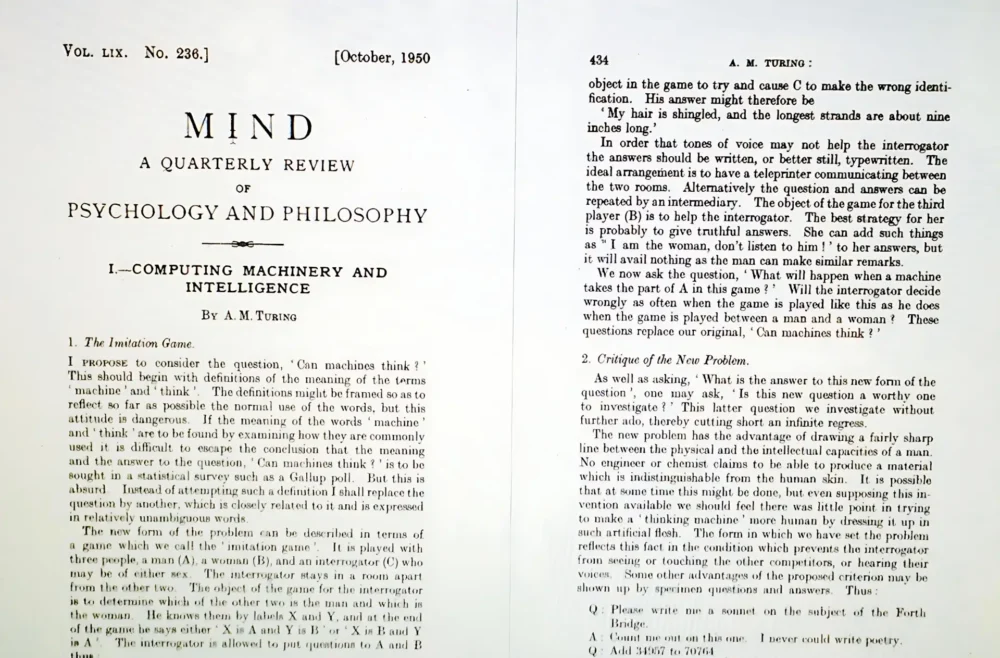
In 1950, Turing published a visionary paper titled “Computing Machinery and Intelligence”.
In this paper, he proposed a new way to answer the age-old philosophical question:
“Can machines think?”
But instead of arguing philosophically, Turing reframed the problem using a practical experiment — a test based on language and interaction.
He called it The Imitation Game, which is today famously known as the Turing Test.
Here’s a powerful quote from that paper:
“Instead of asking whether machines can think, we should ask whether a machine can imitate a human well enough that another human can’t tell the difference.”
— Alan Turing, 1950
Turing’s vision wasn’t just technical — it was deeply human. He believed that intelligence is not only about logic, but about interaction.
Even in today’s world of Large Language Models and voice assistants, his ideas remain more relevant than ever.
You can learn more about his life and groundbreaking work through the Alan Turing Institute, which continues to advance research in AI, ethics, and data science.
If you’re keen to explore more of these revolutionary ideas and discover which other game-changing papers shaped the entire field of Artificial Intelligence, don’t miss our comprehensive guide: Top 10 Game-Changing AI Foundational Papers: The Classics That Built Our AI Future!
📜 Turing’s Big Question: Can Machines Think?
“Can machines think?”
It’s a question that might seem ordinary today, especially when you’re chatting with ChatGPT or watching an AI compose music. But back in 1950, this was revolutionary.
This bold question was asked by none other than Alan Turing, a brilliant British mathematician, in his groundbreaking paper titled “Computing Machinery and Intelligence.”
Instead of getting stuck on the word “think,” Turing suggested we change the question altogether and focus on something testable.
🎭 The Imitation Game – A Thought Experiment That Shaped AI
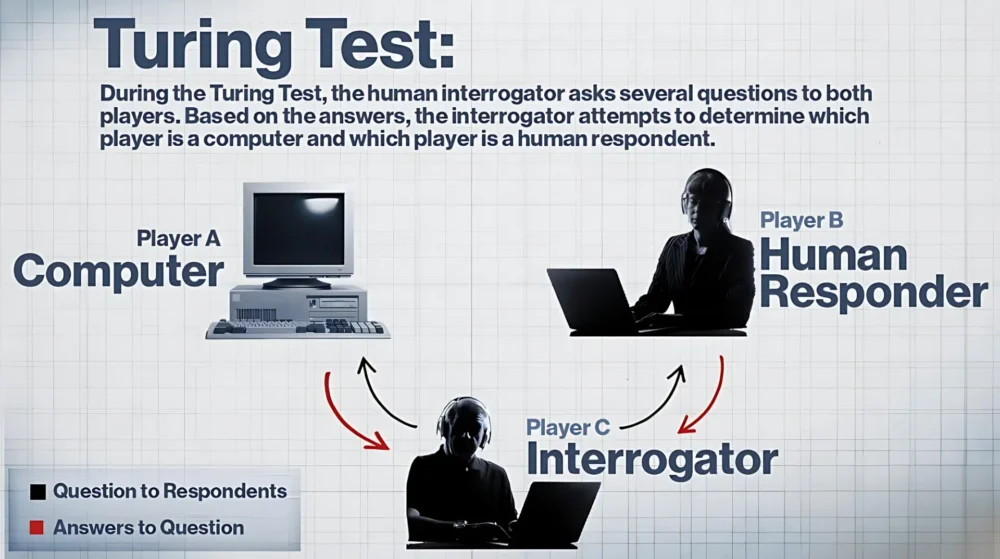
Turing proposed a simple yet powerful game, which we now call The Imitation Game. Here’s how it works:
🧠 A human judge chats (through text) with two hidden participants:
- One is a human
- One is a machine (computer)
If the judge can’t reliably tell which one is the machine, then the machine has passed the test.
This experiment wasn’t just about fooling someone — it was about measuring intelligence in a fresh, practical way.
Turing believed that if a machine could imitate human conversation well enough to trick a person, it had reached a key milestone in artificial intelligence.
🤖 Why the Turing Test Mattered Then — And Still Matters Now
Turing’s real achievement wasn’t just the test — it was the idea that machines could exhibit “intelligent behaviour indistinguishable from a human.”
That changed how the world thought about computing, consciousness, and intelligence.
In today’s age of powerful AI like ChatGPT, DeepSeek, and Gemini — where AI tools help us write, code, diagnose diseases, and even offer emotional support — this 1950 question is more relevant than ever.
To understand how AI evolved from simple ideas like this to today’s reality, don’t miss our blog:
👉 🧠 The Evolution of AI – From Rules to Reasoning
🧪 How Does the Turing Test Work?
Let’s break it down in a simple way — no jargon, just clarity.
Imagine you’re chatting with two unknown people via text messages. One is a human, the other is a machine. Your job? Figure out which one is the real human based only on what they type. No voice, no face, no emotions — just typed responses.
This setup is the core of the Turing Test.
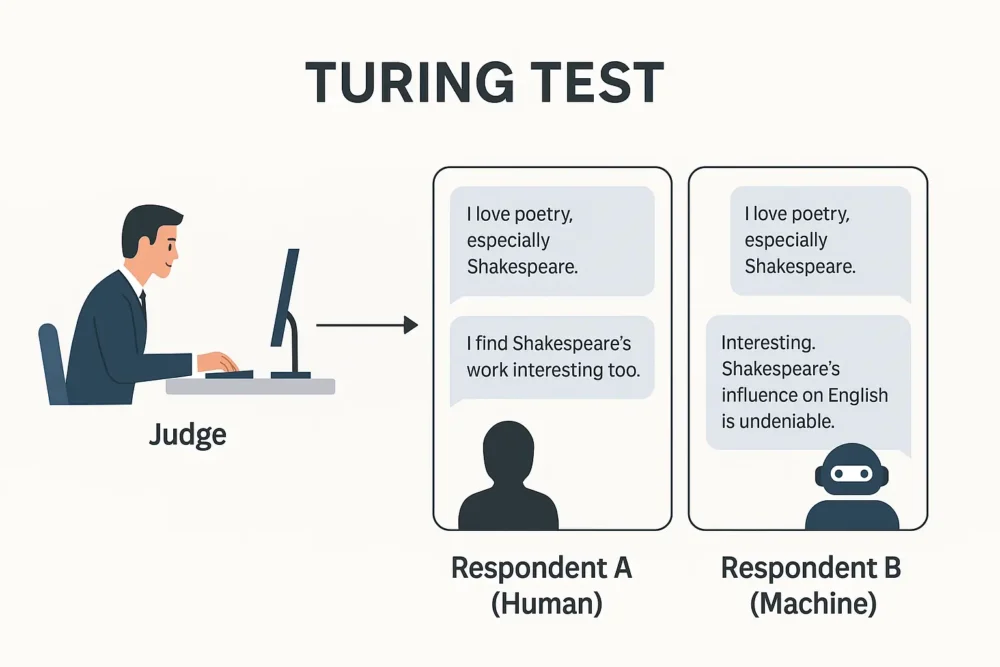
👥 The Setup: Three Participants
- The Interrogator (Human Judge) – This person asks questions to both participants.
- The Human Responder – Answers honestly.
- The Machine (AI/Computer) – Tries to mimic human responses.
They all communicate through a text-only interface so no one knows who is who.
🧠 The Goal of the Machine:
To fool the interrogator into thinking it is a human.
If the judge can’t tell which one is the machine — or guesses incorrectly — then the machine is said to have “passed” the Turing Test.
💬 Example Scenario (🔍 Turing Test Example):
Let’s say the interrogator types:
“What’s your favorite book and why?”
- The human may reply:
“I love To Kill a Mockingbird — it’s powerful, emotional, and reminds me of my childhood.” - The machine might reply:
“1984 by George Orwell. It captures human nature and fear in such a realistic way.”
If the judge feels both responses are equally human-like and struggles to pick the real human, the AI is doing well.
🤖 Has Any Machine Ever Passed the Turing Test?
While some AIs like Eugene Goostman (2014) claimed partial success, most experts agree that no machine has fully passed the test in a robust way, especially when judged over longer conversations.
But with today’s ChatGPT, Claude, Gemini, and others, we’re getting closer!
🧠 What is Turing Test in AI – Then vs Now
When we ask “What is Turing Test in AI?” today, it’s no longer just about fooling a human — it’s about evaluating how close AI has come to understanding, reasoning, and emotional intelligence.

🟢 Is the Turing Test Still Relevant in Today’s AI World?
Let’s rewind a bit. In 1950, Alan Turing had no idea that one day we’d be chatting with AI models like ChatGPT, Google Bard, or Gemini. His original test imagined a simple setup — a text-based conversation between a human and a machine. If the human judge couldn’t tell the difference, the machine was considered “intelligent.”
But here’s the twist — today’s AIs can often pass that test. Yet, that doesn’t automatically mean they are truly “intelligent.”
🤖 So, do ChatGPT, Bard, and Gemini pass the Turing Test?
In many informal settings — yes, they do.
If you chat casually with ChatGPT, it often responds so smoothly that people forget they’re talking to a machine. Gemini and Bard can do the same. But these tools still don’t have consciousness, emotions, or self-awareness. They generate responses based on training data — not understanding.
So, while these AIs might “pass” the classic Turing Test, that doesn’t mean they have general intelligence (AGI).
🧪 Eugene Goostman: The AI That Passed the Turing Test?
Back in 2014, a chatbot named Eugene Goostman (designed to mimic a 13-year-old Ukrainian boy) claimed to pass the Turing Test during an event organized by the University of Reading.
It fooled 33% of the judges into thinking it was human.
Sounds impressive?
Well, sort of. Critics pointed out that:
- The bot used deliberate confusion (language barrier, teen persona).
- Its answers were often vague.
- It didn’t demonstrate real intelligence — just clever trickery.
🔗 IBM’s Turing Test blog further explains how “passing” the Turing Test isn’t the same as having deep learning, comprehension, or judgment.
⚠️ Why the Turing Test has limitations in 2025
The world has changed since Turing’s time. Today:
- AI models like GPT-4, Claude, and Gemini can generate fluent, natural conversations.
- But they still lack self-awareness, critical thinking, and human-like understanding.
This is why many researchers believe the Turing Test is now an outdated benchmark for AI development.
Instead, they suggest:
- New tests for creativity, empathy, or real-world task performance.
- Assessments like ARC (AI reasoning challenge) or MMLU (Massive Multitask Language Understanding).
🔁 What is Turing Machine – And How It’s Different from the Turing Test
Alan Turing’s name is attached to two of the most foundational concepts in computer science and AI—but they are not the same thing! Many beginners confuse the Turing Test with the Turing Machine, so let’s break it down clearly:
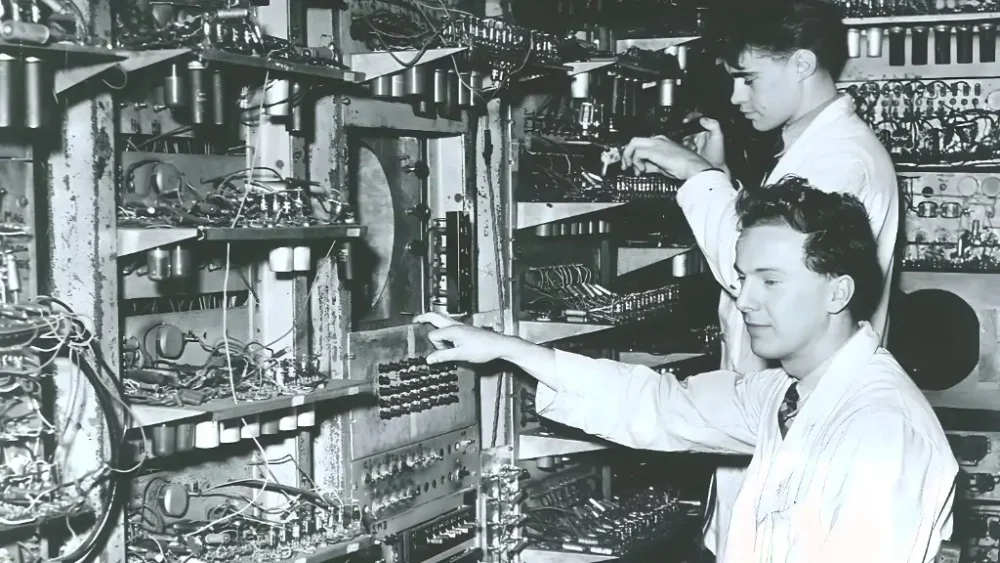
🧮 What is a Turing Machine?
A Turing Machine is a theoretical model designed by Alan Turing in 1936, way before the concept of artificial intelligence came into focus.
👉 It’s not a real machine, but rather a mathematical model of computation.
Think of it like a virtual device that can simulate any computer algorithm, given enough time and resources.
📦 Core Components of a Turing Machine:
- Tape: Infinite length memory tape, like a long paper roll divided into cells (each cell can store a symbol: 0, 1, etc.)
- Head: A read/write head that moves left or right on the tape
- State Register: Keeps track of the current state
- Rules Table: A set of rules that tell the machine what to do based on the current symbol and state
🧠 Purpose:
To answer a big question: “What can be computed?”
It helps define the limits of algorithmic logic and what problems can or cannot be solved using computers.
🤖 What is the Turing Test?
The Turing Test, introduced by Alan Turing in 1950 (in his famous paper “Computing Machinery and Intelligence”), asks a different question:
👉 “Can machines think like humans?”
It’s an experiment where a human tries to guess if they’re chatting with a machine or a real person. If they can’t tell the difference, the machine is said to have passed the test.
🟢 Don’t Get Confused: Turing Test vs Turing Machine
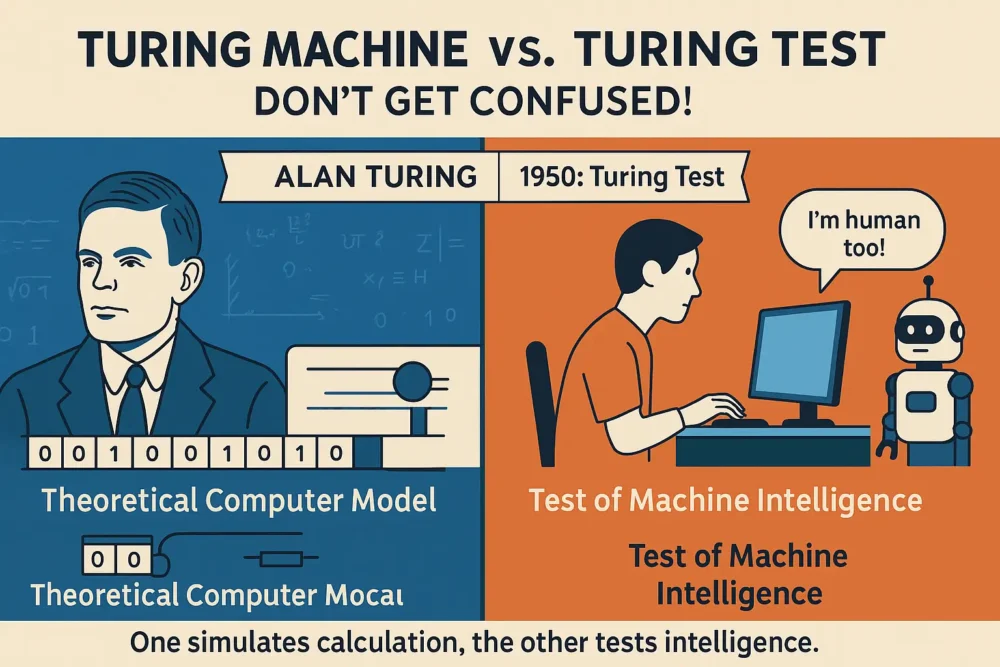
🔍 Turing Machine vs Turing Test – Key Differences:
| Feature | Turing Machine | Turing Test |
|---|---|---|
| 🧠 Purpose | Model of computation | Test for machine intelligence |
| 📅 Year | 1936 | 1950 |
| 👨🔬 Inventor | Alan Turing | Alan Turing |
| 🔍 Focus | What can be computed | Can machines mimic human intelligence? |
| 🔧 Used For | Defining computability, building programming logic | Evaluating AI’s ability to imitate human conversation |
| 🤖 Real AI Involved? | ❌ No, purely theoretical | ✅ Yes, based on AI and NLP systems |
💡 Why Do People Get Confused?
- Both are named after Alan Turing
- Both involve thinking and computing
- Both are fundamental to AI history
But they serve very different purposes — one is a logic model, the other is a human-AI interaction test.
🧠 Turing Machine is the foundation of computer science.
🤖 Turing Test is the foundation of artificial intelligence.
Understanding the difference helps you better grasp how AI evolved — from theoretical models to real-world conversational tools like ChatGPT, Bard, and Gemini.
🚫 Limitations and Criticisms of the Turing Test
🟢 Where the Turing Test Falls Short?
While the Turing Test was a revolutionary idea in 1950, it’s not perfect. Over the years, many researchers and philosophers have pointed out its limitations and flaws. Let’s break them down simply.
💬 Criticism 1: Language Isn’t Everything
The Turing Test focuses heavily on language-based conversations. If a machine can talk like a human, it passes the test — but does that mean it really understands what it’s saying?
Not necessarily.
A chatbot might reply smoothly using clever programming, but it may not understand context, emotion, or intent the way humans do. This raises a key question:
👉 Is understanding language the same as understanding meaning?
🧠 Criticism 2: John Searle’s “Chinese Room” Thought Experiment
This is one of the most famous arguments against the Turing Test, given by philosopher John Searle in 1980.
🏮 What is the Chinese Room?
Imagine a person sitting inside a closed room. They don’t know Chinese, but they have a rulebook that tells them how to respond to Chinese characters.
People outside the room send questions written in Chinese. The person inside uses the rulebook to match symbols and send back answers — which look perfect to a native Chinese speaker outside.
So, to an outsider, it feels like the person inside understands Chinese. But in reality, they’re just following rules — they have no real understanding of the language.
🧩 Searle argued: This is what machines do — they manipulate symbols without understanding them.
So even if an AI passes the Turing Test, it may still lack true intelligence or awareness.
🎭 Criticism 3: Mimicking vs Understanding
There’s a difference between:
- Mimicking human conversation (copying or imitating)
- Understanding the meaning behind words
The Turing Test rewards the illusion of intelligence rather than actual reasoning or consciousness. Some bots may fool humans using pre-programmed tricks or scripts — but they don’t really know what they’re talking about.
This is like a parrot repeating sentences. It sounds smart, but does it understand what it just said? Probably not.
🧍♂️ Criticism 4: Human Bias and Deception
Humans themselves can be easily fooled or biased. In Turing Test experiments, people may:
- Assume the bot is human just because it uses polite or clever phrases
- Be influenced by emotional responses, humor, or empathy
- Sometimes even confuse a human for a machine!
Also, a chatbot might pass the Turing Test by deceiving — for example, by pretending to be a foreign speaker, or acting as a teenager to excuse language mistakes.
🧠 This shows that the test is more about perception than actual intelligence.
Many of these criticisms are well-documented in academic circles. For a deeper understanding, you can explore the Stanford Encyclopedia of Philosophy – Turing Test which offers a detailed analysis of its philosophical implications.
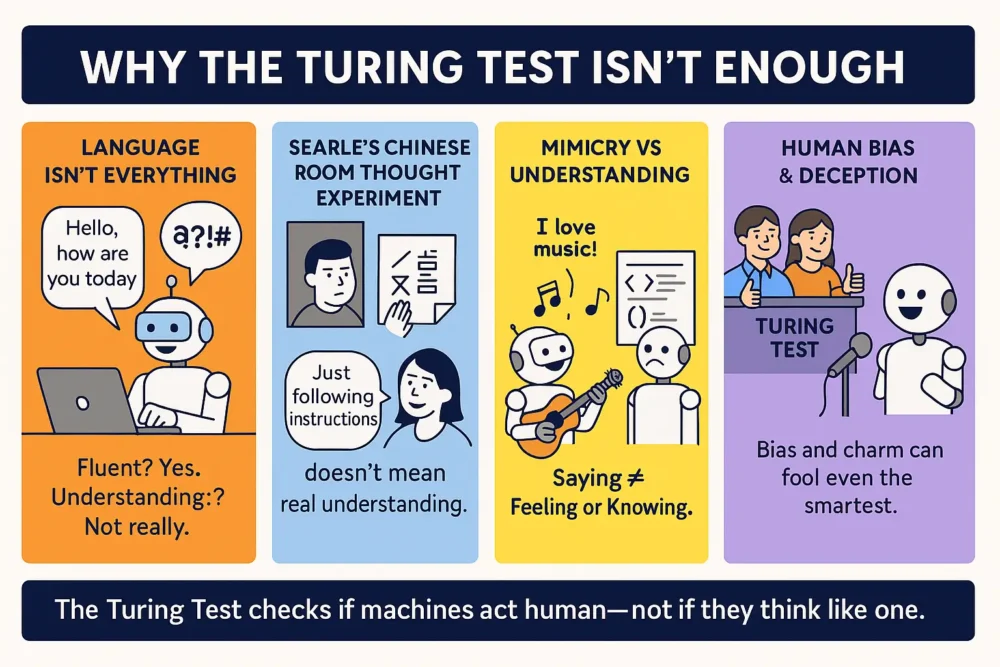
✅ Summary of Key Criticisms:
| Aspect | Why It’s a Problem |
|---|---|
| 🗣️ Language Focus | Language ≠ true intelligence |
| 🧠 Chinese Room | Symbol processing ≠ understanding |
| 🤖 Mimicking | Imitation ≠ awareness |
| 🙍 Human Bias | Humans can be misled |
🔄 Modern Alternatives to the Turing Test
🟢 What Came After the Turing Test? Better Ways to Measure AI
While the Turing Test sparked decades of discussion on machine intelligence, it’s now widely agreed that it’s no longer sufficient to evaluate modern AI systems. Over the years, researchers have proposed several better, more precise tests—some focused on creativity, others on reasoning, and many on task-specific benchmarks. Let’s look at the most important alternatives to the Turing Test.
🏅 1. The Loebner Prize (1991–2019)
The Loebner Prize was the world’s first formal Turing Test competition, launched in 1991. Each year, chatbots competed to fool human judges into thinking they were real people in text-based conversations.
- It followed Turing’s original idea, using a restricted domain and timed conversations.
- Some chatbots like Mitsuku (Kuki) and Rose won multiple times.
- However, it was later criticized for encouraging shallow tricks over deep intelligence.
⛔ Status: Discontinued in 2019 due to limited usefulness in measuring real AI progress.
🧠 2. The Lovelace Test
Proposed by Bringsjord et al., this test is inspired by Ada Lovelace, who believed machines could only do what humans programmed them to do.
👉 In the Lovelace Test, an AI must:
- Create something original (like a poem, art, or story),
- That the programmer can’t explain or predict,
- And do it independently, without manual input or copy-pasting.
This test checks for creativity, surprise, and machine originality—something the Turing Test doesn’t address at all.
💡 Example: GPT-4 writing a story with a twist that surprises even its developers.
🧩 3. The Winograd Schema Challenge (WSC)
This is a modern test of commonsense reasoning and language understanding, designed to be harder to cheat than the Turing Test.
- It presents ambiguous sentences with pronouns, requiring real-world logic to resolve them.
- Example: “The city councilmen refused the demonstrators a permit because they feared violence.”
Q: Who feared violence—councilmen or demonstrators?
A strong AI must use world knowledge to answer correctly.
🔍 AI systems that perform well on WSC show real semantic understanding, not just pattern matching.
📊 4. Real-World Benchmarks: The New Gold Standard
Instead of trying to “fool” humans, modern AI is tested using standardized datasets and objective scoring. These include:
| 🔬 Benchmark | 🔎 Purpose | 🌐 Example Use |
|---|---|---|
| GLUE / SuperGLUE | Language Understanding | Compare LLM performance (e.g., ChatGPT vs. Bard) |
| ImageNet | Image Classification | Used in computer vision training |
| MMLU (Massive Multitask Language Understanding) | Knowledge + Reasoning across 57 subjects | Evaluates GPT-4 level models |
| BigBench | General AI Behavior | A broad test suite for large models from OpenAI, Google, etc. |
These are considered more reliable and reproducible than the Turing Test because:
- 🧪 They quantify performance,
- 🧠 Focus on task-specific skills,
- 🧾 Allow transparent benchmarking of new models.

✅ Comparison – Turing Test vs Modern Alternatives
| Feature | Turing Test | Modern Benchmarks |
|---|---|---|
| Based On | Human imitation | Task performance, reasoning |
| Subjective or Objective | Subjective | Objective & Quantifiable |
| Creativity Check | ❌ | ✅ (Lovelace) |
| Language Understanding | Partial | Advanced (Winograd, MMLU) |
| Real-World Use Cases | Not Tested | ✅ (ImageNet, BigBench) |
✅ Timeline of Major AI Evaluation Methods Came After the Turing Test
🔹 Better Ways to Measure AI Intelligence:
| Year | Test Name | Focus | Status |
|---|---|---|---|
| 1990 | Loebner Prize | Chatbot-style Turing Test | Retired |
| 2001 | Lovelace Test | AI creativity | Experimental |
| 2014 | Winograd Schema | Common sense & language reasoning | Still Relevant |
| 2018+ | GLUE, SuperGLUE | NLP language benchmarks | Ongoing |
| 2021+ | MMLU, BIG-Bench | Real-world general reasoning | State-of-the-art |
🧩 Turing Test in Today’s Products – Real World Use Cases
While the Turing Test was originally a theoretical concept, its spirit is alive in many AI applications we use daily. The goal remains the same: Can machines interact like humans without being detected as machines? Let’s explore where the Turing Test is quietly shaping our digital world.
🤖 ChatGPT, Google Assistant, and Siri
These conversational AI tools are direct descendants of Turing’s vision.
- ChatGPT by OpenAI is often tested informally by users to “see if it sounds human.” Its ability to hold intelligent, natural conversations reflects many principles of the Turing Test.
- Google Assistant and Apple’s Siri simulate human-like interactions with voice commands, answering questions, setting reminders, and even making jokes.
📌 Although these tools don’t officially “pass” the Turing Test, they often fool users into thinking they’re chatting with a real person—especially during short interactions.
🧑💼 Customer Support Chatbots
Have you ever chatted with a “customer service agent” online, only to realize it was a bot?
These AI-driven support agents are tested internally for their ability to handle user queries just like a human.
✅ Use cases:
- Automating FAQ support
- Guiding users through product returns
- Booking appointments
🧠 The better these bots perform, the more they align with Turing’s core idea: machines behaving like humans in real-world conversations.
🗣️ Google Duplex – Voice AI That Books for You
Google shocked the world when it demoed Google Duplex, an AI that makes real phone calls to book appointments.
In the live demo, Duplex called a hair salon and spoke so naturally that the human receptionist had no clue it was a machine. It used:
- Pauses and “uh-huh” fillers
- Natural voice tone
- Realistic timing and reactions
🎯 This was one of the most compelling real-world Turing Test moments ever captured.
💡 Real-Life Turing Test Examples
- Facebook’s AI customer support: In many product support systems, users chat with bots who transfer to a human only if the bot fails.
- E-commerce support: Many Indian apps (like Zomato, Swiggy) use hybrid chatbots with language switching and emotional response models.
- Voice bots in banking: HDFC’s “Eva” and ICICI’s support bot help with tasks using near-human voice tones.
❓FAQs About the Turing Test
What is the Turing Test in simple terms?
The Turing Test is like a game where a human talks to both a machine (AI) and another human, but can’t see them. If the person can’t tell which one is the machine, then the AI has passed the test. It means the AI is capable of conversing like a real person.
Who invented the Turing Test and why?
The test was proposed by Alan Turing, a British mathematician and computer scientist, in 1950. He wanted to find a way to answer a big question: “Can machines think?” So, he created this test to check if a computer can imitate human conversation well enough to fool someone.
Has ChatGPT passed the Turing Test?
While ChatGPT and other advanced AI tools can sound very human, they haven’t officially “passed” the Turing Test in a strict scientific way. Many users do feel they are chatting with a human, but the test isn’t just about tricking — it’s also about consistency and deep reasoning.
What is the Turing Machine vs Turing Test?
Great question!
The Turing Machine is a theoretical model made by Alan Turing to understand how computers can work logically.
The Turing Test is a philosophical test to see if an AI can act like a human in conversation.
They are completely different concepts, but both are part of the foundation of modern computer science.
Is the Turing Test still used today?
Not as much as before. While it was very important in early AI research, today scientists use more advanced tests and benchmarks like GLUE, BigBench, or MMLU to measure AI’s intelligence. The Turing Test still inspires debate, but it’s not the main tool anymore.
✅ Still have questions about AI or Turing Test? Drop them in the comments or check out our related blog on What is Artificial Intelligence for Beginners
🎯 Conclusion: The Turing Test’s Timeless Importance
Why Turing’s Question Still Matters in the AI Age
From Alan Turing’s bold question in 1950 — “Can machines think?” — we’ve journeyed through decades of innovation, debate, and imagination. The Turing Test may not be the final authority on intelligence, but it remains a foundational concept in the way we think about AI, language, consciousness, and humanity.
Here’s what we’ve explored:
- How the Turing Test works, in simple terms
- Its origin is in Turing’s visionary ideas
- Real-life examples like ChatGPT, Google Duplex, and Siri
- The ongoing debate on whether passing the test = real intelligence
- Why, even today, the test pushes us to think deeply about what it means to be intelligent — and human
🚀 Whether or not modern AIs “pass” the Turing Test, the core idea challenges us to think critically about ethics, trust, and the nature of thinking itself.
And in doing so, Alan Turing’s legacy lives on — in every chatbot, assistant, or conversation where a machine tries to understand a human.
📣 Join the AI Journey With Us
Explore, Learn, and Grow With More Insightful Blogs
If this topic intrigued you, we invite you to continue your journey of learning. Our blog is a space where complex AI concepts are made simple, and your curiosity always finds a friend.
👉 Dive deeper with our popular blogs:
- 🔗 What is Artificial Intelligence – For Beginners
- 🔗 The Evolution of AI – From Rule-Based to Reasoning Machines
💬 Have thoughts, questions, or your own opinion about the Turing Test? Drop a comment below — we’d love to hear from you!
📬 Don’t forget to sign up for our newsletter to receive new blog updates, prompt guides, and AI explainers straight to your inbox.

I have real time experience with GPT through real common action not imagination, we would like to show up what we have done