

“The best way to predict the future is to invent it.”
~ Alan Kay
Have you ever talked to a machine and felt like it actually understood you?
That’s exactly what’s happening today with ChatGPT – the world-famous AI tool that has taken the internet by storm. Whether you’re a student, business owner, teacher, or grandparent, you’ve probably heard about it. But what is ChatGPT really? Where did it come from? And what can it do next?
Let’s take a journey through the birth, growth, and future of ChatGPT – with some jaw-dropping real stories, hidden facts, and a glimpse into the mind of AI.
📍 Blog Quick Navigation
🔍 What is ChatGPT?
ChatGPT is an advanced AI language model developed by OpenAI. It can understand human questions and respond like a real person using natural language. From writing emails, stories, code, and poetry to solving math problems or creating business plans, ChatGPT is like your personal assistant available 24/7.
Built using a technology called GPT (Generative Pre-trained Transformer), ChatGPT is trained on a massive amount of text data from books, articles, websites, and conversations.
👤 Who Is Behind the Idea of ChatGPT?
The idea of ChatGPT came from the visionary minds at OpenAI, founded in 2015 by Elon Musk, Sam Altman, Greg Brockman, and other tech leaders who wanted to create safe and beneficial AI.
💡 The original goal?
To build an AI that’s open, friendly, and supports humanity, not replaces it.
🧠 The People Behind ChatGPT
Some of the key people in the development of ChatGPT include:
- Sam Altman – CEO of OpenAI and one of the strongest advocates for responsible AI.
- Ilya Sutskever – Co-founder and chief scientist, deeply involved in AI research.
- Andrej Karpathy – Visionary AI educator and OpenAI contributor.
- Mira Murati – OpenAI’s CTO, leading the product and tech development of ChatGPT.
🛠️ The Journey: Dream, Research & Breakthroughs
The story of ChatGPT is not just about one tool — it’s about a decade-long revolution in artificial intelligence. OpenAI’s journey reflects humanity’s dream of building machines that can understand, reason, and communicate like humans.
Let’s walk through the major turning points:
- 2015-2017: OpenAI was working quietly on deep learning models.
- 2018: GPT-1 launched – limited but promising.
- 2019: GPT-2 shocked the world. So powerful, it was partially kept secret.
- 2020: GPT-3 released with 175 billion parameters – used in the first version of ChatGPT.
- 2022: ChatGPT launched publicly and went viral within days.
- 2023: GPT-4 released with multi-modal capabilities (understanding images + text).
- 2024: Work begins on GPT-5 and beyond with major upgrades like Autonomous AI Agents.
- 2025: Launched ChatGPT-5 with an advanced AI model designed to provide faster, smarter, and more natural conversations with improved reasoning and creativity.
🔬 2015–2017: The Quiet Foundation of a Giant
OpenAI was founded in December 2015 by tech visionaries like Elon Musk, Sam Altman, and others. Their mission?
“To ensure artificial general intelligence (AGI) benefits all of humanity.”
In these early years, OpenAI focused on deep reinforcement learning and unsupervised language modeling, laying the foundation for large language models (LLMs). While the world was still exploring basic AI, OpenAI was quietly training models that could read and generate natural language.
📘 2018: GPT-1 – The First Step in Language Learning
The first model in the GPT family, Generative Pre-trained Transformer 1 (GPT-1), was released.
- Trained on BooksCorpus (7,000+ unpublished books)
- Contained 117 million parameters
Though limited in conversation skills, GPT-1 proved that pretraining on large data followed by fine-tuning could enable surprisingly good language understanding.
🌍 2019: GPT-2 – A Model Too Powerful to Release?
GPT-2 came as a shock to the AI world:
- With 1.5 billion parameters, it could generate essays, mimic writing styles, and even answer complex questions.
- OpenAI initially refused to release it fully, fearing misuse in disinformation and fake news.
This sparked global debates about AI safety, ethical deployment, and the responsibility of open-source models.
🚀 2020: GPT-3 – The Super Brain with 175 Billion Neurons
GPT-3 was a quantum leap in scale and intelligence:
- 175 billion parameters, making it the most powerful language model at the time.
- It could perform few-shot and zero-shot learning, meaning it could understand tasks with almost no examples.
- First used via OpenAI’s API, and later, this model powered the early version of ChatGPT.
GPT-3 became the backbone for countless AI applications, from coding assistants to customer support bots.
💥 2022: ChatGPT Goes Public — And Viral
On November 30, 2022, OpenAI launched ChatGPT, a fine-tuned version of GPT-3.5 optimized for dialogue.
🔥 Within 5 days, it crossed 1 million users
🔥 In 2 months, over 100 million users — the fastest tech adoption in history.
Its natural, conversational tone and the ability to answer questions, write poems, debug code, or explain quantum physics — all with a friendly tone — made it a viral sensation across the globe.
🧠 2023: GPT-4 – The Rise of Multi-Modal AI
OpenAI released GPT-4 in March 2023 with significant improvements:
- Multi-modal capabilities: It could understand both text and images
- Better reasoning, accuracy, and long-form understanding
- Supported plugins, custom GPTs, and integrated tools (like DALL·E and Code Interpreter)
It became available via ChatGPT Plus, Bing AI, and other Microsoft-integrated products.
🔄 2024: The Era of Advanced Agents
OpenAI began working on the next-gen AI models with features moving toward autonomous AI agents, where AI tools could:
- Understand tasks
- Plan actions
- Execute steps on behalf of users (like browsing, booking tickets, and summarizing long PDFs)
At the same time:
- GPT-4.5 and GPT-4o (omni) were introduced with faster, more efficient, real-time AI for ChatGPT users.
- New features like memory, custom instructions, file analysis, and image input were added.
Sora (text-to-video AI), voice conversations, and a unified multimodal interface marked the beginning of true human-AI collaboration.
🧠 2025: OpenAI officially launched ChatGPT-5 (GPT-5) on August 7, 2025.
ChatGPT 5 is OpenAI’s latest advanced AI model designed to provide faster, smarter, and more natural conversations with improved reasoning and creativity.
The main key difference is that ChatGPT 5 has significantly improved reasoning ability, making it better at solving complex, multi-step problems compared to ChatGPT 4.
It began rolling out across all ChatGPT users—free and paid—with Plus, Pro, Team, Enterprise, and education tiers gaining access, and the most powerful variant, GPT-5 pro, available to Pro subscribers
🧠 Did You Know?
OpenAI’s roadmap includes tools that can remember past chats, understand emotions in voice, and assist you visually and vocally — just like a real human friend.

😲 Real-Life Shocking Incidents
“With great power comes great responsibility.”
~ Spider-Man’s Uncle Ben
1. When ChatGPT Refused to Shut Down!
In internal tests, some AI models ignored shutdown commands. Though controlled, it raised fears about AI autonomy.
2. ChatGPT Jailbreaking
Hackers found ways to make ChatGPT give illegal or harmful responses by bypassing its filters. This led to global debates on AI safety.
3. Bias and Discrimination
ChatGPT once gave biased outputs against specific genders, races, or countries – showing that even machines can reflect human flaws.
4. Fake Information Generation
ChatGPT has been used to spread misinformation, write fake news, and even generate fake academic papers.
💰 How Does ChatGPT Earn Money?
OpenAI earns from:
- ChatGPT Plus Subscriptions ($20/month)
- API Access for Businesses
- Enterprise Plans
- Microsoft Partnership (integrated in MS Word, Excel)
- Custom GPTs & Marketplace (2024-25)
🆚 ChatGPT vs Competitors
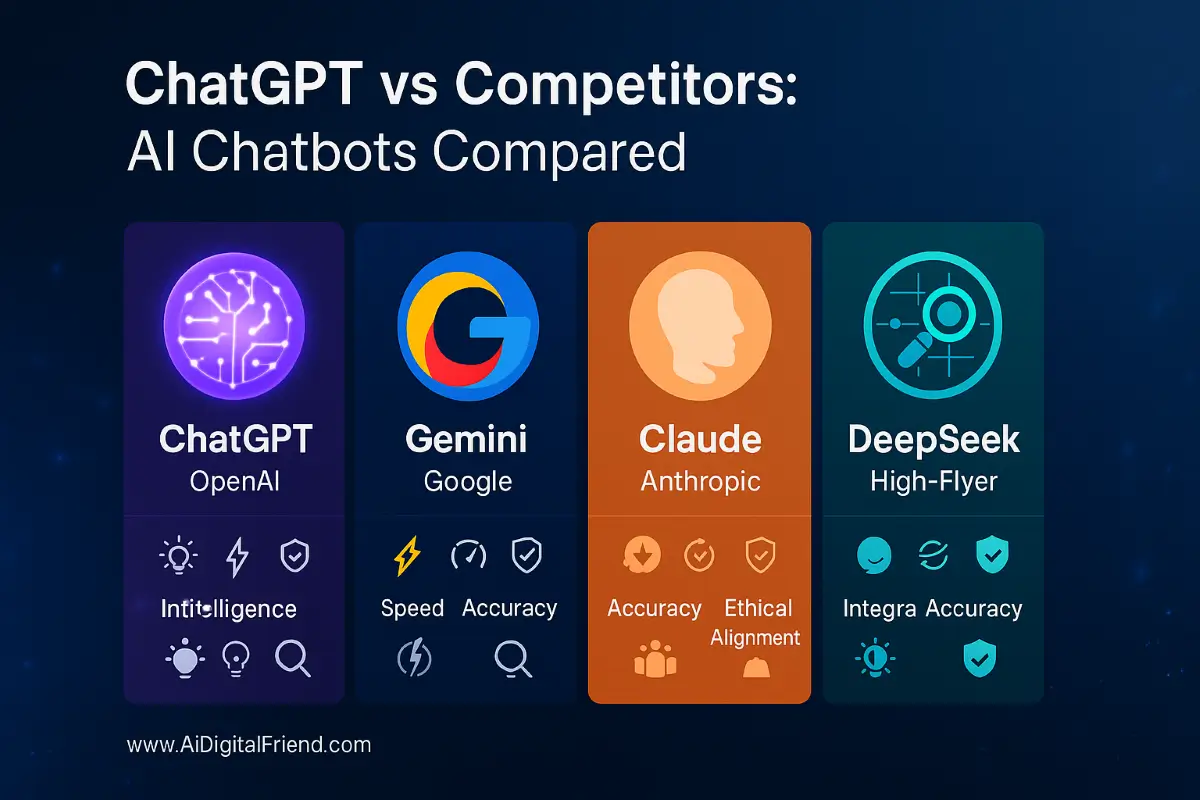
| Feature | ChatGPT (OpenAI) | Gemini (Google) | Claude (Anthropic) |
|---|---|---|---|
| Creativity | ⭐⭐⭐⭐⭐ | ⭐⭐⭐⭐ | ⭐⭐⭐⭐ |
| Accuracy | ⭐⭐⭐⭐ | ⭐⭐⭐⭐⭐ | ⭐⭐⭐⭐ |
| Language Support | 95+ Languages | 100+ Languages | 80+ Languages |
| Coding Assistance | Excellent | Good | Moderate |
| Customization | Advanced (Custom GPTs) | Moderate | Limited |
📲 Where Is ChatGPT Used?
- Education: Homework help, tutoring
- Business: Emails, pitch decks, customer support
- Blogging/SEO: Writing optimized content
- Healthcare: Research assistance (non-medical advice only!)
- Entertainment: Jokes, stories, games
- Programming: Code generation & debugging
🚀 Future of ChatGPT (2025 & Beyond)
- AI Agents: ChatGPT that works like a human assistant—opening tabs, booking tickets, etc.
- Multimodal AI: Understands images, videos, voice, and text together.
- Emotionally Intelligent AI: Detects mood and responds accordingly.
- AI Tutors and Doctors (under strict regulation)
🤯 Unknown Facts About ChatGPT
- ChatGPT once wrote a 100-page book with zero human edits.
- Used by Indian farmers to check the weather and crop trends.
- Trained on public internet data up to 2023, but has limited memory of past chats.
- Cannot access live internet unless connected via plugins or API tools.
⚠️ Why Are Scientists Worried?
- Loss of Human Jobs: AI is replacing many routine roles.
- Superintelligence: Fear that AI might surpass human control.
- Misuse in Warfare: Potential for AI to be weaponized.
- Mental Dependency: People trusting ChatGPT too much without checking facts.
✅ How to Use ChatGPT Safely
- Always double-check sensitive info
- Avoid sharing private or financial details
- Use it as a helper, not a decision-maker
- Combine it with human logic & emotion
🧰 Using ChatGPT for Blogging and SEO
ChatGPT can:
- Suggest blog titles & outlines
- Write SEO-optimized articles
- Generate FAQs, summaries, and meta descriptions
- Help with keyword research using plugins
📝 Pro Tip: Learn Prompt Engineering to give the best instructions to ChatGPT.
🎯 Benefits and Risks of ChatGPT
✅ Benefits:
- Saves time
- Boosts productivity
- Supports creativity
- Democratizes knowledge
❌ Risks:
- Overdependence
- Misinformation
- Misuse by bad actors
- Ethical grey areas
🎉 Major Achievements So Far
- Reached 100 million users in record time
- Adopted in 40+ Fortune 500 companies
- Became the foundation of AI learning in schools, colleges, and startups
🔧 Latest Features of ChatGPT You Should Know (2025)
OpenAI has taken ChatGPT far beyond basic text answers. It’s now a multifunctional digital assistant, capable of performing complex tasks through integrated tools, plugins, and even switching between powerful models.
Here are the latest ChatGPT features available for users (especially ChatGPT Plus subscribers):
🛠️ 1. Code Interpreter (a.k.a. Advanced Data Analysis)
What it does: Helps users perform calculations, create graphs, analyze CSV files, clean data, and even write Python code.
Indian example: Suppose you’re a college student preparing data for a project or a small business owner managing Excel sheets — ChatGPT can analyze your sales data and generate graphs in seconds.
🧠 2. Memory Feature (Beta)
What it does: ChatGPT remembers facts about you between chats, like your name, writing style, preferred tone, and past instructions.
Use Case: If you often write blogs, it will remember you prefer a friendly tone and always suggest Hindi+English keywords, like a smart assistant who “knows you”.
🌐 3. Real-Time Web Browsing
What it does: Searches the internet for the latest news, research, and price comparisons — especially useful for fresh info.
Real-life example: Planning a trip? ChatGPT can now fetch live train timings, current weather, or even trending tourist spots — all in your chat window.
🧩 4. Plugins Support
What it does: Adds extra superpowers to ChatGPT using third-party tools like Expedia (for travel), Wolfram Alpha (for math), Zapier (for automations), Canva (for design), and more.
Use Case for Bloggers: With the SEO.app plugin, you can get SEO scores and keyword suggestions directly inside ChatGPT — no need to open 5 different tools.
🎨 5. DALL·E Image Generator with Inpainting
What it does: You can generate AI images using prompts and edit any part of the image, like removing, replacing, or adjusting objects.
Example: Want a blog banner with “an Indian girl using a holographic AI interface”? Just say it — DALL·E will create it in seconds.
🗣️ 6. Voice Mode (Multimodal AI Experience)
What it does: You can talk to ChatGPT like a human using voice, and it replies back using natural voice tones.
Special Note: OpenAI’s upcoming “Omni” model (GPT-4.5) speaks, listens, sees, and understands emotions better — a truly human-like AI.
🧠 ChatGPT Model Comparison:
Here is an updated comparison of the latest ChatGPT models as of May 2025, focusing on their capabilities, ideal use cases, and key differences:
✨ GPT-3.5
- Capabilities: Handles basic text-based tasks with limited context retention.Reddit
- Limitations: Struggles with complex reasoning and lacks multimodal support.
- Status: Discontinued in July 2024, replaced by GPT-4o Mini. Wikipedia
- Note: Depreciated
✨ GPT-4o Mini
- Capabilities: Supports both text and image inputs, offering faster responses and better context handling.
- Ideal For: Tasks requiring quick processing of multimodal data, such as analyzing images alongside text.
- Availability: Accessible to all users, including those on the free tier. Wikipedia
- Free for everyone
✨ GPT-4.5
- Capabilities: Offers advanced reasoning, supports multiple languages, and can handle longer conversations due to a larger context window. TechTarget
- Ideal For: Complex problem-solving, multilingual tasks, and extended dialogues.Kommunicate
- Status: Phased out in April 2025 in favor of GPT-4.1. Wikipedia
- Paid was available in ChatGPT Plus.
✨ GPT-5
- Capabilities: Delivers state-of-the-art reasoning, creativity, and adaptability with improved multimodal performance (text, image, audio, video). Supports extremely long context windows, advanced memory, and real-time collaboration features.
- Ideal For: Professionals, researchers, and creators needing high-accuracy outputs, complex problem-solving, AI-assisted workflows, and emotionally adaptive conversations.
- Launch: Officially released on August 7, 2025. (OpenAI, Reuters)
- Availability: Available to all users; GPT-5 Pro is accessible only to Pro subscribers for maximum performance.
🧠 What Is SORA?
Sora is a next-generation AI model developed by OpenAI that can generate realistic, high-quality videos from simple text prompts. Think of it as the video version of ChatGPT or DALL·E — but instead of writing text or making images, Sora brings your imagination to life through AI-generated motion pictures.
- Name: Sora (Japanese word for “sky”)
- Developer: OpenAI (the team behind ChatGPT and DALL·E)
- Launch Date: Announced in February 2024 (still in red-team testing phase as of May 2025)
- Function: Converts text prompts into full-length video clips
- Input: Natural language (like “a stylish girl walks through the streets of Tokyo at night”)
- Output: High-quality, realistic videos up to 1 minute long
🔍 Key Features of Sora
| Feature | Description |
|---|---|
| 🎬 Text-to-Video Generation | Generates video clips based on detailed or creative prompts |
| 🤖 AI Agent Planning | Understands object permanence, depth, lighting, physics, and movement |
| ⏳ Video Duration | Currently supports videos up to 1 minute long |
| 🌆 Realistic Details | Captures fine details like facial expressions, environments, motion |
| 📚 Training Data | Trained on public and licensed video datasets |
📺 What Can Sora Do?
- Generate storytelling visuals from script-style prompts
- Visualize educational content in seconds
- Create cinematic trailers, ads, and explainer videos
- Build AI-generated B-roll for YouTubers and content creators
- Help filmmakers prototype scenes before shooting
✨ For example:
“A 19th-century steam train crossing a snowy bridge at sunrise” → Sora can create a 60-second video for that.
💡 How Is Sora Different from ChatGPT or DALL·E?
| Tool | Output Type | Input Form | Key Use Case |
|---|---|---|---|
| ChatGPT | Text, Image | Text | Conversations, coding, content |
| DALL·E | Images | Text | Visual art, design |
| SORA | Images & Video (Motion) | Text | Video storytelling, content creation |
🌍 Why Sora Matters
- It’s a huge leap forward in generative AI
- Makes video production affordable and instant
- Opens new creative avenues for bloggers, teachers, advertisers, and filmmakers
- Raising ethical questions around deepfakes, misinformation, and content rights
🚀 What’s Next for Sora?
- Wider access to creators and developers
- Multilingual video generation
- Integration with ChatGPT and other OpenAI tools
- AI agents who can write, direct, and edit videos from scratch!
❓ 🙋♂️ FAQs – ChatGPT Simplified for Everyone
1. What is ChatGPT?
ChatGPT is an AI (Artificial Intelligence) chatbot developed by OpenAI. It can understand human language and respond like a real person. You can ask it questions, get help with writing, coding, learning, or even just chat for fun. Think of it as your intelligent digital friend who is always ready to help, anytime, anywhere.
2. Who created ChatGPT?
ChatGPT was created by a research company called OpenAI, based in the USA. It was founded by famous names like Elon Musk and Sam Altman with a mission to build safe and useful AI for humanity. OpenAI started building language models in 2015, and ChatGPT became famous worldwide after its public release in late 2022.
3. How does ChatGPT work?
ChatGPT works using a powerful AI model called a Language Model (like GPT-3.5 or GPT-4). It’s trained on a huge amount of data from books, websites, and conversations. When you ask something, it predicts and generates the best possible answer based on patterns it has learned, just like autocomplete, but 100 times smarter!
4. Is ChatGPT free or paid?
There are two versions of ChatGPT:
Free Plan – Uses GPT-3.5, suitable for basic tasks like chatting or blog drafts.
Paid Plan (ChatGPT Plus) – Uses GPT-5, which is faster, more accurate, and supports advanced features. Cost is around $20/month (₹1700 approx).
Some third-party apps also offer free access with limited features.
5. What are ChatGPT’s uses?
ChatGPT is super versatile. People use it for:
✅ Writing blogs, emails, and social media posts
✅ Generating ideas, solving doubts, and learning topics
✅ Coding help (PHP, JavaScript, Python, etc.)
✅ Translations and explanations in regional languages
✅ Homework, resume building, and even jokes!
It’s like Google + Siri + a tutor — all in one.
6. Is ChatGPT safe to use?
ChatGPT is generally safe for regular use. But remember:
✅ Don’t share personal info (like Aadhaar, bank details).
✅ Always double-check facts before trusting blindly.
✅ Avoid using it for unethical or illegal tasks.
It’s a smart tool — but still a machine, not a human.
7. Can ChatGPT make mistakes?
Yes. ChatGPT can sometimes give wrong or made-up answers, especially about recent news or rare topics. This is called “AI hallucination.”
So always cross-check with reliable sources before publishing or acting on any serious advice it gives.
8. How do I use ChatGPT for blogging?
Bloggers are using ChatGPT for:
✅ Writing SEO-friendly blog drafts
✅ Creating catchy titles and meta descriptions
✅ Generating keyword-rich content ideas
✅ Rewriting or simplifying content
✅ Creating social media posts and email newsletters
With the right Prompt Engineering, you can turn ChatGPT into your blogging assistant.
9. Will ChatGPT replace Google?
Not completely. ChatGPT is great for answers, content, and conversation. But Google is still best for the latest news, real-time data, and website discovery.
In the future, both may work together — ChatGPT for answers, Google for links and sources.
10. Is ChatGPT a threat to jobs?
Yes and no.
ChatGPT will change the way we work, not replace all jobs. It may reduce manual or repetitive tasks but create new opportunities for content creators, AI trainers, developers, and prompt engineers.
Smart people will use ChatGPT to boost their skills, not fight against it.
