

🌟 Introduction: The Secret Sauce of AI’s Success!
Ever wondered how AI got so smart? It didn’t happen overnight! From self-driving cars to chatbots that talk like humans, today’s Artificial Intelligence (AI) stands on the shoulders of giants – brilliant minds and their groundbreaking AI foundational papers. These papers are like the secret recipes that helped AI grow from just an idea to the powerful technology we see all around us.
This blog is your ticket to a thrilling journey through the history of AI papers. We’ll explore the most influential AI papers that laid the groundwork for everything, from how computers “learn” to how they can “see” and “understand” our language. Whether you’re a tech enthusiast or just curious about AI, this guide to AI foundational papers is super easy to understand, even if you’re not a tech expert. These aren’t just old academic texts; they represent important AI breakthrough papers that sparked revolutions and are truly AI development milestones papers.
📍 Blog Quick Navigation
🧠 Before the Boom: Understanding the AI Landscape (Pre-Foundational Papers Era)
Imagine a time when computers were just big calculators. People started asking: “Can machines think?” This was a huge philosophical question. Back then, there weren’t many ideas on how a machine could mimic human intelligence. But some smart people, like Alan Turing, started dreaming big. Their visions, even before formal “AI” was a thing, paved the way for the AI foundational papers that would soon follow. It’s like preparing the soil before planting the seeds of a revolutionary idea!
📜 What Exactly Are AI Foundational Papers and Why Do They Matter?
Think of AI foundational papers as the very first instruction manuals or blueprints for different parts of AI. Just like a building needs a strong foundation, AI needed these core ideas to grow. Each of these classic AI publications introduced a brand-new concept, solved a big problem, or changed how we thought about machines and intelligence.
These papers are important because:
- They set the rules: They gave researchers a common language and framework to discuss AI.
- They solved big puzzles: They offered solutions to challenges that seemed impossible at the time.
- They sparked new ideas: Each paper often led to many more new ideas and research.
- They are the base: Without these early AI research documents, today’s advanced AI, like the ones discussed in our blog on the Evolution of Artificial Intelligence, wouldn’t exist! They define what AI foundational papers are in the truest sense.
🚀 The Classics: Top 10 Game-Changing AI Foundational Papers That Built Our Future!
Here are the key AI papers explained that truly shaped the world of AI:
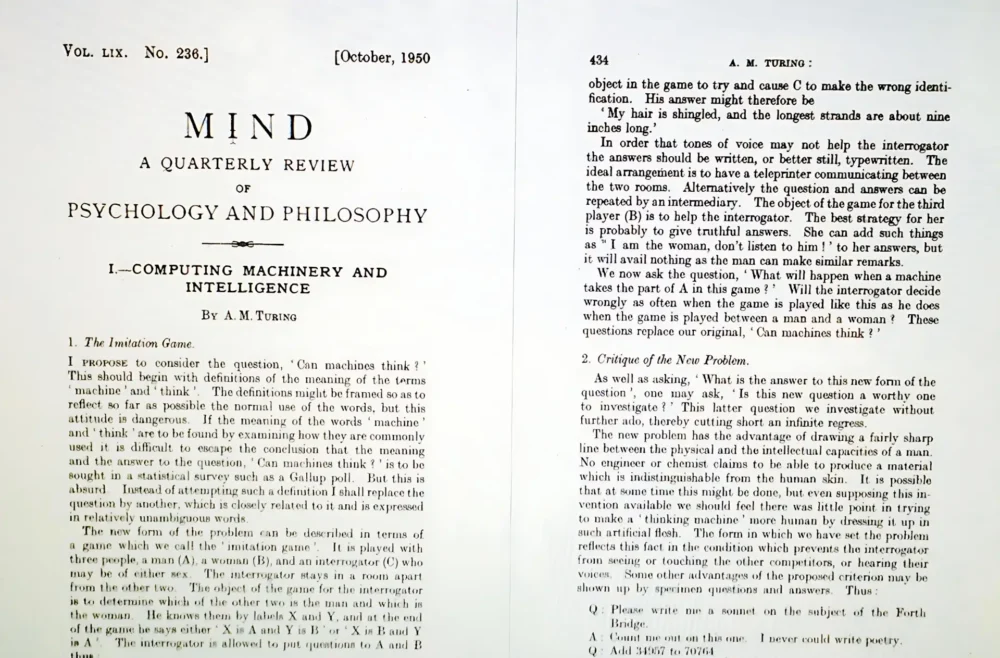
1. ⚡️ “Computing Machinery and Intelligence” by Alan Turing (1950)
The Big Idea: This paper introduced the famous Turing Test. It’s basically a game to see if a machine can talk like a human, so well that you can’t tell it’s a machine.
Why it’s Foundational: It was the first time someone gave a clear, practical way to test if a machine could “think” or show intelligence. It literally laid the first brick for measuring AI.
Its Legacy Today: The Turing Test is still debated, but it continues to influence how we think about AI’s ability to interact with us. Modern chatbots and AI assistants often try to pass this kind of test. Want to know more? Check out our detailed blog on the Turing Test!
2. ⚡️ “Programs with Common Sense” by John McCarthy (1959)
The Big Idea: McCarthy, who also coined the term “Artificial Intelligence,” suggested that AI programs should have “common sense” – meaning they should be able to reason and learn from what they experience, just like humans do.
Why it’s Foundational: This paper pushed the idea of symbolic AI, where AI systems would use logic and symbols to represent knowledge and solve problems.
Its Legacy Today: This paper influenced early AI systems that focused on knowledge representation and reasoning, like expert systems used in diagnostics.
3. ⚡️ “Perceptrons” by Frank Rosenblatt (1958)

The Big Idea: Rosenblatt introduced the Perceptron, which was one of the very first neural network models. Think of it as a super simple artificial brain cell that could learn to classify things, like telling an apple from an orange.
Why it’s Foundational: It was a big step towards machine learning, showing that machines could learn directly from data, rather than needing explicit rules.
Its Legacy Today: Even though very basic, the Perceptron is the great-grandparent of all modern neural networks and deep learning models that you can read about in our blog on Neural Networks!
4. ⚡️ “Perceptrons” by Marvin Minsky & Seymour Papert (1969)
The Big Idea: This wasn’t a paper, but a very influential book! Minsky and Papert showed the limitations of simple Perceptrons, proving they couldn’t solve complex problems.
Why it’s Foundational: This book, though critical, actually pushed AI research forward by showing what didn’t work. It contributed to what’s called the “AI Winter,” a period when funding and interest in AI dropped. But it also forced researchers to think about new ways to build AI.
Its Legacy Today: It indirectly led to the development of multi-layered neural networks and algorithms like backpropagation, which overcame the problems they highlighted.
5. ⚡️ “Learning representations by back-propagating errors” by Rumelhart, Hinton, & Williams (1986)
The Big Idea: This paper brought back the idea of neural networks with a bang! It popularized backpropagation, a super smart algorithm that teaches multi-layered neural networks how to learn complex patterns from data.
Why it’s Foundational: Backpropagation was the missing piece that made training deep (multi-layered) neural networks possible and efficient. It reignited the field of neural networks.
Its Legacy Today: This algorithm is the backbone of almost all modern deep learning, making complex AI models feasible. It’s truly a cornerstone for today’s AI, like the large language models we discuss in other blogs on AI.
6. ⚡️ “Gradient-based learning applied to document recognition” by Yann LeCun et al. (1998) (LeNet-5)
The Big Idea: This paper showed how Convolutional Neural Networks (CNNs), specifically LeNet-5, could be used to recognize handwritten digits (like those on cheques!).
Why it’s Foundational: It proved that CNNs were incredibly effective for image recognition tasks, paving the way for the field of computer vision.
Its Legacy Today: LeNet-5 is the conceptual ancestor of powerful CNN architectures (like AlexNet, VGG, ResNet) that run modern image recognition, facial detection, and even self-driving car vision systems.
7. ⚡️ “The ImageNet Large Scale Visual Recognition Challenge” by Deng et al. (2009) (ImageNet Dataset)
The Big Idea: This wasn’t just a paper; it was about creating a massive, organized dataset of over a million images, each with a label describing what’s in it. They also started a yearly competition based on this dataset.
Why it’s Foundational: ImageNet became a benchmark, a tough test for AI models. The competition pushed researchers to build incredibly powerful image recognition systems, leading to the “deep learning revolution” in computer vision.
Its Legacy Today: It’s still a standard for evaluating computer vision models. The breakthroughs it sparked are used in everything from smartphone cameras to medical imaging.
8. ⚡️ “Playing Atari with Deep Reinforcement Learning” by Mnih et al. (DeepMind, 2013)
The Big Idea: This paper showed that an AI could learn to play classic Atari video games (like Breakout or Pong) simply by looking at the screen pixels and getting a score, without any human telling it what to do. This combined Deep Learning with Reinforcement Learning.
Why it’s Foundational: It proved the incredible power of Deep Reinforcement Learning (DRL) for learning complex tasks from scratch, just like humans learn by trial and error.
Its Legacy Today: This research paved the way for more advanced AIs like AlphaGo (that beat the world Go champion) and systems that control robots or optimize complex processes.
9. ⚡️ “Adam: A Method for Stochastic Optimization” by Diederik P. Kingma & Jimmy Ba (2014)
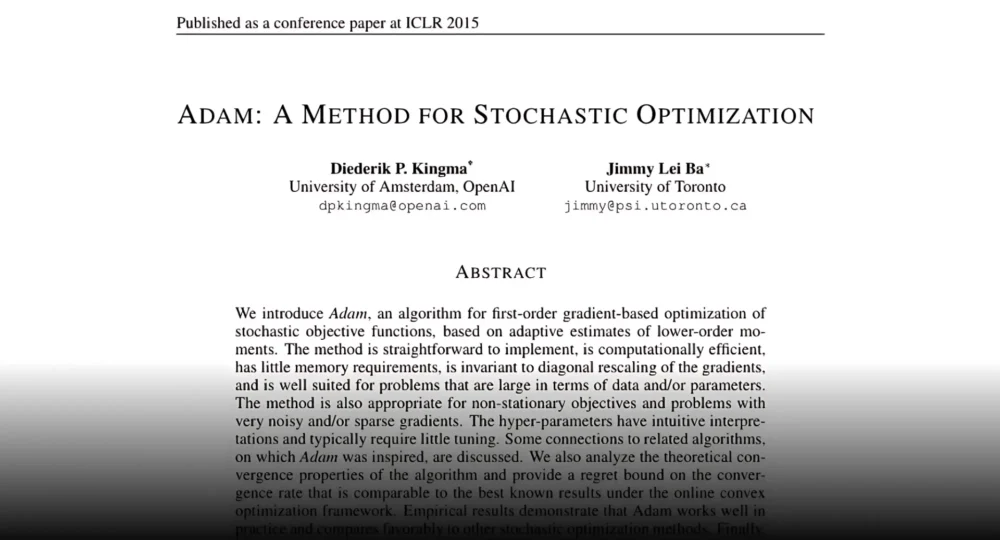
The Big Idea: This paper introduced a new optimization algorithm called Adam. Think of an optimizer as the “trainer” for an AI model, helping it learn faster and more efficiently. Adam was a super-efficient trainer!
Why it’s Foundational: It made training really complex deep learning models much easier and more stable, saving researchers a lot of time and effort.

Its Legacy Today: Adam is one of the most widely used optimization algorithms in deep learning today. If you’re training a neural network, chances are you’re using Adam!
10. ⚡️ “Attention Is All You Need” by Vaswani et al. (Google Brain, 2017)
The Big Idea: This paper introduced the Transformer architecture. Before this, models processed language word by word. Transformers use “attention” mechanisms to look at all words in a sentence at once, understanding their relationships much better.
Why it’s Foundational: It completely revolutionized Natural Language Processing (NLP) and opened the door to much larger and more capable language models.
Its Legacy Today: The Transformer is the fundamental architecture behind almost all modern Large Language Models (LLMs) like ChatGPT, Google’s Gemini, and BERT. It’s an essential AI paper every Gen AI developer must read!
🚧 From Theory to Practice: How These Papers Shaped AI Development
These AI foundational papers weren’t just stuck in academic journals. Many of them were brought to life through open-source initiatives and community efforts. Platforms like Papers With Code allow researchers to share their code alongside their papers, making it easier for others to build upon their work. Similarly, GitHub repositories like awesome-ai-papers curate important papers, showing how practical implementation is key. Also, the rapid improvement in computer hardware, especially GPUs, made it possible to actually run the complex calculations these papers envisioned!
🔭 The Legacy Lives On: AI’s Future Built on Foundational Bricks
The ideas from these AI foundational papers are not just historical footnotes; they are the living, breathing DNA of today’s AI. Every new breakthrough, from the latest research papers on platforms like ArXiv to the top AI research papers of 2024, builds directly on the concepts introduced decades ago.
The ongoing quest for Artificial General Intelligence (AGI) – AI that can perform any intellectual task a human can – still relies on understanding these early ideas. For anyone serious about AI, truly understanding these best AI academic papers is crucial.
🎯 Conclusion: AI’s Past, Present, and Future – All in One Paper!
So there you have it – a deep dive into the AI foundational papers that truly changed everything! This journey shows us that AI isn’t magic; it’s the result of decades of brilliant minds building upon each other’s work. Each paper was a stepping stone, helping us understand more about how machines can learn, reason, and interact with our world.
AI is a continuously evolving field, with each new breakthrough building on the last. By appreciating these fundamental contributions, we can better understand where AI is headed and how it will continue to shape our future.
📚 Further Reading & References
- Want to explore more about AI? Check out our other blogs on AI advancements and concepts: Explore AI on AIDigitalFriend.com
- For in-depth academic discussions, you can visit journals like the Journal of Artificial Intelligence Research (JAIR): JAIR Official Website
- Some research institutions also curate lists of important papers: IAIFI Papers
❓ Frequently Asked Questions (FAQs) – AI Foundational Papers
What exactly are AI Foundational Papers?
AI foundational papers are the early, highly important research documents that laid the groundwork for Artificial Intelligence (AI). Think of them as the initial blueprints or instruction manuals that introduced major new ideas or solutions, pushing forward different fields within AI like machine learning, computer vision, or natural language processing. These papers are essentially the bedrock upon which all of today’s advanced AI technologies are built.
Why are these papers so crucial in the AI journey?
These papers are crucial because they didn’t just open new paths for AI; they solved significant challenges and introduced revolutionary concepts. They taught us how to make machines learn, how they could “see,” “understand” our language, and even “reason.” Without these foundational works, the smart devices, self-driving cars, and chatbots like Gemini and ChatGPT that we use today simply wouldn’t exist. They’re the critical first steps in AI’s incredible journey.
Are these “foundational” papers still relevant today?
Absolutely, yes! These AI foundational papers are still highly relevant. Their core ideas continue to be the basis for new research and development. For instance, the Transformer paper from 2017, which we discussed in the blog, is the very foundation of all modern Large Language Models (LLMs) like GPT and Gemini. These papers are essential for understanding the fundamental principles that govern today’s AI.
Is it hard for a non-technical person to understand these papers?
Some AI foundational papers can be quite technical and involve complex math. However, the aim of this blog is to simplify them for you. We’ve explained the big ideas behind each paper and their impact in easy-to-understand language, so anyone, regardless of their technical background, can grasp these historical achievements and their significance.
Has AI passed the Turing Test yet?
It’s difficult to say conclusively whether any AI has fully passed the Turing Test. In 2014, a chatbot named “Eugene Goostman” claimed to have fooled judges, but many experts didn’t consider it a true pass. Today’s advanced AI models, like Google’s Gemini or OpenAI’s ChatGPT, can have incredibly sophisticated conversations, but they’re not yet perfect and can often still be identified as machines by humans.
Where can I learn more about AI?
To learn more about AI, you can explore our AIDigitalFriend.com blog, where you’ll find numerous informative articles on topics like the Evolution of Artificial Intelligence, Neural Networks, and even guides on AI-assisted blogging. You can also delve into reputable academic journals and research websites like ArXiv or Google Scholar for deeper insights.
Stay Ahead in the AI Game! 🚀 Don’t miss out on the latest AI trends and breakthroughs. Subscribe to AIDigitalFriend.com for more in-depth guides and insights!
